Decorating a Living Room in Poole and Bournemouth: Feature Walls and Bold Trim Ideas
Thinking about a living room feature wall in Poole or Bournemouth? We share practical ideas, colour tips and what the process looks like from start to finish.

A Single Wall Can Change Everything
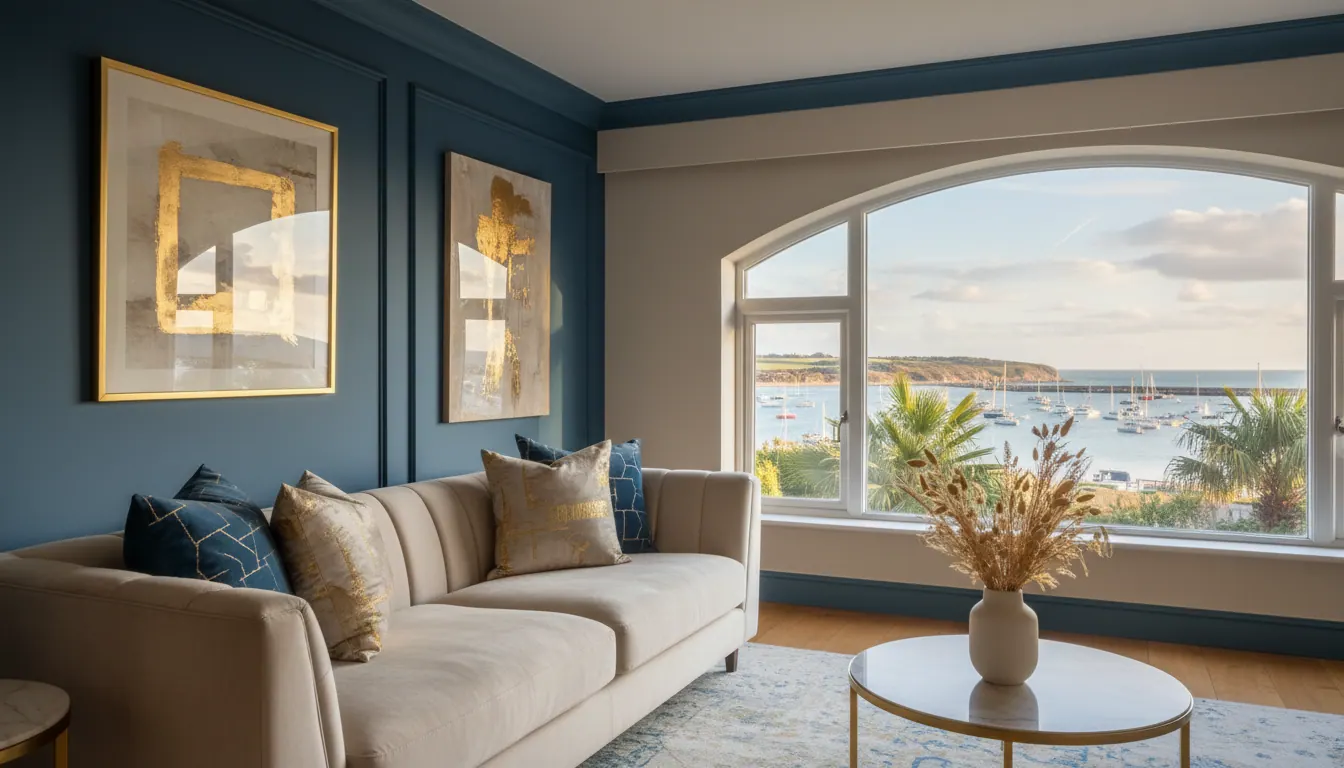
A feature wall is one of the most satisfying decorating jobs in a home. One wall, done properly, can anchor a room, give it a focal point and make the whole space feel considered rather than accidental. It is also far less disruptive than a full repaint, which is part of why we have seen real interest in statement finishes from homeowners right across Poole, Bournemouth and Dorset lately.
If you have been scrolling through ideas and wondering what would actually work in your specific room, this guide is for you. We will walk through which walls tend to work best, which colours and finishes suit Dorset homes, and what the process looks like when we come in to do the job.
Which Wall Should Be the Feature Wall?
This is the question most people get stuck on. The short answer: it is usually the wall your eye lands on first when you walk into the room.
In most Poole and Bournemouth living rooms, that tends to be:
- The chimney breast wall, if there is one
- The wall behind a sofa or main seating area
- The wall facing the main window
A back wall behind a sofa or media unit is the most popular choice right now. It frames the room without competing with natural light, and it gives you something to hang artwork against if you want to layer the look further.
What you want to avoid is picking a wall that already has a lot of interruptions: multiple doorways, awkward alcoves, or a radiator dead centre. Those walls can still work, but they need more thought.
Colour Ideas That Suit Poole and Dorset Living Rooms
The coastal setting here does influence colour choices, even in rooms that do not overlook the water. Poole Harbour, the heathland around Canford Heath and Broadstone, the sandy tones of Sandbanks and the greener stretches towards Wareham and Ferndown all feed into what feels natural in a Dorset home.
That said, the trend we are seeing locally is not just "go coastal blue". It is more nuanced than that.
Muted, earthy neutrals work brilliantly as feature walls in rooms that already have white or off-white on the other three walls. Think warm taupes, soft terracottas, dusty sage greens and chalky clay tones. These read as calm and considered, and they age well.
Deep, rich colours are having a real moment. Navy, forest green, charcoal and deep plum can all work on a single wall without making a room feel oppressive. In fact, on one wall they often make the room feel more grounded and intentional. Rooms in Hamworthy and Parkstone terraces, which can sometimes feel a little box-like, respond particularly well to this treatment.
Warm whites and very pale tones are still a valid choice if the goal is to create a subtle contrast rather than a dramatic one. A soft warm white on a feature wall, with a slightly cooler white on the other walls, reads as a quiet distinction that lifts the room.
If you are unsure which direction to go, we are always happy to talk through the options when we come to quote. That is exactly the kind of conversation we had with Jim and Rose (reviewed below) before their full house repaint.
What Our Customers Say
KC decorators did a full paint job in our 3 bed house and we're so happy with how it looks. Gave us loads of advice about what colours to go for as we just couldn't make our minds up. Very tidy, very clean and very good with communication throughout the entire job. Highly recommend
Thanks again from Jim and Rose
That colour advice is not a bolt-on extra. It is part of how we work. A feature wall is a commitment, and we would rather spend ten minutes talking through the options than have you live with a colour you are not sure about.
Preparation: The Part That Makes the Finish
A feature wall only looks as good as what is underneath it. This matters more than the paint brand, more than the colour, more than almost anything else.
Before any paint goes on, we check the wall carefully:
- Filling and sanding. Cracks, nail holes and uneven patches all need addressing. On an older Poole or Bournemouth property, there can be more of this than expected, particularly in Victorian and Edwardian terraces in Parkstone and Christchurch.
- Cleaning and degreasing. Especially in rooms where cooking smells or smoke have settled into the walls over the years.
- Priming. If the wall has been freshly filled, or if you are going from a pale colour to a very dark one (or vice versa), a primer coat is not optional. It is what stops the finish looking patchy.
If the wall currently has wallpaper on it, that needs to come off first and the surface needs time to dry and settle before painting. We have written more about that process in our guide to stripping wallpaper the right way.
Cutting in neatly at the edges, the ceiling line and around skirting and architrave is where a professional finish really earns its keep. Clean lines are what separate a feature wall that looks intentional from one that just looks painted.
Finish Options: Matt, Eggshell or Satinwood?
The sheen level you choose affects how the colour reads and how practical the wall is to live with.
Matt emulsion is the most popular choice for feature walls. It absorbs light rather than reflecting it, which makes colours look richer and more saturated. It is also the most forgiving on walls that are not perfectly flat. The trade-off is that it marks more easily than other finishes.
Eggshell emulsion has a very subtle sheen. It is slightly more washable than matt, which makes it a reasonable choice in family homes or rentals where the walls take a bit more traffic. The colour reads slightly differently under different lights, which can be a positive or a negative depending on the room.
Satinwood is more commonly used on woodwork, but some people do use it on a feature wall for a very deliberate high-contrast effect. It is a specific look, and it is worth thinking carefully before committing.
For most living rooms in Poole and Bournemouth, we would lean towards a quality matt emulsion on a feature wall. It tends to give the most satisfying result.
Pairing the Feature Wall with the Rest of the Room
The feature wall does not exist in isolation. The other three walls, the ceiling, the woodwork and the floor all interact with it.
A few things that work well:
- Keep the other walls neutral. A warm white or soft off-white lets the feature wall breathe without competing.
- Match or complement the trim. If your skirting and door frames are brilliant white, a cool-toned feature wall will sit more comfortably than a very warm one.
- Think about the floor. Pale wood or light carpet tends to work with almost anything. A dark floor can make a very dark feature wall feel heavy.
- Consider your furniture. If you have a large sofa in a strong colour, a feature wall in a clashing tone will create visual noise. Neutral furniture gives you more freedom.
If you are also thinking about refreshing the rest of the room at the same time, our article on decorating a bedroom in Poole covers some of the same colour-pairing principles and is worth a read even if it is your living room you are working on.
What Happens When We Come to Do the Job
We keep things simple and tidy. Before we start, we protect your floor, furniture and any fittings that are staying in place. We work methodically: preparation first, then primer where needed, then the finish coats.
We do not rush the drying time between coats. That patience is part of what gives a finish its depth and durability.
When we are done, we clear up fully. The room should look better, not like a decorator has just been in it.
Frequently Asked Questions
How many coats of paint does a feature wall need? Usually two finish coats over a properly prepared and primed surface. If you are going from a very light colour to a deep or saturated one, you may need an additional coat or a tinted primer to get full, even coverage. We assess this when we see the wall.
Do I need to move all my furniture before you arrive? It helps to move smaller items and clear the wall you want done. We can work around larger pieces of furniture, but the more access we have, the quicker and cleaner the job goes. We cover everything that stays in the room.
Can you help me choose the right colour for my living room in Poole? Yes. When we come to quote, we are happy to talk through what you are trying to achieve. We do not make the decision for you, but we can help you think it through based on the room's light, size and what is already in it.
How long does it take to paint a feature wall? A single feature wall in a standard living room typically takes the best part of a day once you include preparation, priming where needed and two coats with drying time in between. Every job is slightly different, so we will give you a realistic timescale when we quote.
Ready to Get Started?
A living room feature wall is one of those jobs that makes an immediate difference. If you are in Poole, Bournemouth, Wareham, Broadstone, Canford Heath, Christchurch, Ferndown or anywhere across Dorset, we would be glad to come and take a look.
Call us on 07778 228478 for a free, no-obligation quote. Send us some photos of the room if that is easier and we can start the conversation from there.